
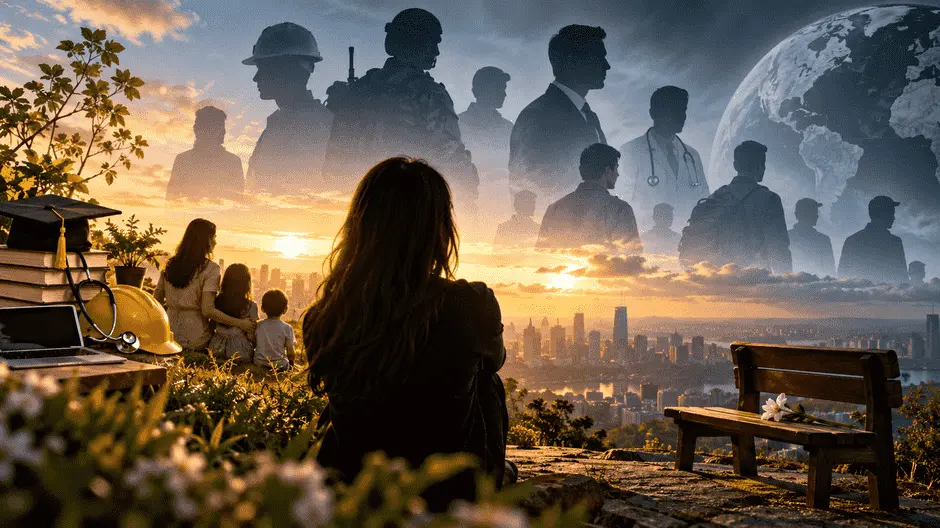
Imagine waking to a world where half the sky has gone quiet a thought experiment, not a verdict. This collection explores a “World Without Men” with respect and realism: how society might grieve, adapt, and rebuild; how resilience, responsibility, and balance could take new forms. Rather than sensationalize absence, these reflections ask better questions about safety, memory, leadership, and care. By contemplating what might be missing, the aim is to see more clearly what everyone needs to thrive coexistence, dignity, and shared purpose.
Here are 27 original quotes on “A World Without Men
Every part of society depends on other parts to remain strong and balanced. When one important support is removed, the remaining support has to carry a burden it was never designed to handle alone. This can create weakness, pressure, and instability. A strong society needs cooperation, balance, and shared responsibility. In simple words, we become stronger when we support each other instead of leaving one side to carry everything alone.
Using nature as a metaphor, this quote suggests that every role in an ecosystem is irreplaceable. The absence of men wouldn’t create a paradise; it would trigger a slow, silent unraveling of systems we often take for granted.
When one group of people is no longer available, the remaining people have to take on responsibilities they did not normally handle. They must learn new skills and adapt to situations that are unfamiliar to them. This can create pressure, but it can also encourage flexibility and self reliance. In simple words, when circumstances change, people must adapt and learn to handle more responsibilities.
An empty chair can remind us that someone is no longer there to handle an important responsibility. Their absence can make others understand how much work they were carrying. It teaches us that every role has value and cannot always be taken for granted. In simple words, absence can teach us to recognise responsibility and understand the importance of every person’s contribution.
The sudden loss of billions of people would create an enormous sense of emptiness across the world. The silence would not feel peaceful because countless relationships, responsibilities, and memories would be left unfinished. People who remain would struggle with unanswered questions and painful goodbyes. In simple words, such a massive loss would leave behind a silence filled with grief, confusion, and unanswered questions.
When the people who created and supported something are suddenly gone, their contribution may not be immediately understood. The systems they built may continue to exist, but they can become difficult to maintain without the knowledge behind them. Their absence can expose how much society depended on their skills, work, and experience. In simple words, you cannot remove the people who built something and expect everything to continue working as if nothing has changed.
Conflict does not come from only one gender, because disagreements and struggles are part of human society. Removing one group of people would not automatically remove the reasons behind conflict. At the same time, losing people who carried historical memories could mean losing important knowledge about past conflicts. In simple words, removing people does not remove the causes of conflict, but it can make society forget the lessons of the past.
Family life and care would continue, but the absence of fathers, grandfathers, brothers, and sons would be deeply felt. Everyday moments that once included them could bring back memories and sadness. The love within the family would remain, but it would now be mixed with a sense of loss. In simple words, love can continue after someone is gone, but their absence can become part of every memory and family moment.
Human history is made through the contributions of many different people and groups. Debates about who contributed more can sometimes hide how deeply different contributions are connected. If half of humanity suddenly disappeared, countless experiences, achievements, and memories would disappear with them. In simple words, history becomes incomplete when the voices and contributions of a large part of humanity are lost.
When a large loss happens, loneliness can affect every part of daily life. People may feel that something important is missing from their relationships, families, and communities. This feeling can influence how they connect with others and how they see the future. In simple words, deep loneliness can become a constant part of life and change the way people think, feel, and live.
The sudden absence of loved ones can make ordinary moments feel painful and unfamiliar. Women may continue with their daily lives while constantly remembering the people who are no longer there. Familiar places, routines, and memories can bring back the feeling of their absence. In simple words, life may continue, but the memories of those who are gone can remain present in everyday moments.
A complete and meaningful society needs different people and contributions working together. Removing one important part does not make the remaining parts more valuable or powerful. Instead, it can create gaps and make the whole system less balanced. In simple words, harmony comes from different parts working together, and removing one part can make the whole picture incomplete.
Factories and essential systems may still have people capable of operating them, but sudden and massive grief could make normal work extremely difficult. People affected by loss may struggle to focus, make decisions, and maintain regular routines. This emotional burden could also reduce productivity and the ability to keep complex systems running smoothly. In simple words, deep grief can affect not only emotions but also people’s ability to maintain the systems that society depends on.
A sudden disappearance of such a large part of humanity would become a major turning point in human history. People would remember life before the event and compare it with everything that came after it. Future generations would grow up learning about the world that existed before the loss. In simple words, such a loss would permanently divide human history into a before and an after.
Future generations of girls would grow up with many questions about the people who were suddenly gone. They might ask about fathers, brothers, sons, and the role those people once played in families and society. Mothers could find these questions difficult because the answers would be connected to personal loss and painful memories. In simple words, some questions created by a great loss cannot be fully answered through books because they are deeply connected to human emotions and memories.
Equality is about giving people equal respect, opportunities, and rights regardless of gender. It does not mean removing one group or making one side disappear. A balanced society depends on people with different experiences and contributions living and working together. In simple words, true equality means creating balance and respect, not creating emptiness by removing one side.
Nature would continue its normal cycle even after a huge loss in humanity. The oceans would rise, seasons would change, and life on Earth would continue as before. But human relationships and emotions would be deeply affected by the absence of so many people. In simple words, the world may continue normally, but the human heart can carry a lasting sense of loss and emptiness.
People would create memorials to remember those who were suddenly lost and to preserve their place in history. These monuments would remind future generations that these people were once an important part of everyday life. They could also bring feelings of sadness, regret, and questions about what could have been done differently. In simple words, the memorials would keep their memories alive while reminding survivors of the huge loss they experienced.
People may stop focusing on differences between groups when a huge loss makes them realise how much they depended on each other. Instead, they would face a much deeper feeling of loneliness and incompleteness. The absence of so many people would change how society understands relationships, community, and human connection. In simple words, the loss of one side would make people realise the importance of having others beside them.
Love does not disappear when someone is gone. People can continue to care deeply for those they have lost through memories, emotions, and the moments they shared. But without the person being there, that love can also bring sadness and loneliness. In simple words, love can remain even after someone is gone, but it can become mixed with the pain of missing them.
Beyond the emotional and societal impact, the biological consequences would be irreversible. The genetic diversity of the human species would suffer a catastrophic reduction that no technology could fully restore.
A world may become physically safer in some ways, but safety alone cannot provide a fulfilling human life. People also need relationships, companionship, emotional support, and a sense of community. Removing an entire group would create major emotional and social losses that safety cannot replace. In simple words, a safe world can still feel empty if people lose meaningful human connections.
The first few years after a major loss may be filled with strong grief and painful memories. As time passes, people may adjust to the new reality, but memories of those who are gone can slowly become less clear. Future generations may know about them only through stories, photographs, and history. In simple words, the deepest loss may not only be losing people but slowly losing the memory of what life was like when they were still here.
Removing a major part of society would not make the remaining world automatically better or complete. At first, many systems might continue working and the damage may not be obvious. Over time, the missing contributions, relationships, knowledge, and experiences would become more visible. In simple words, a world can continue functioning on the surface while becoming deeply incomplete underneath.
People may become strong when difficult circumstances force them to take on responsibilities they never expected. This strength does not mean they are free from sadness, fear, or exhaustion. Carrying every responsibility alone can create a heavy emotional and practical burden. In simple words, being strong because you have no choice can be very difficult, especially when you never wanted to carry everything alone.
There may be plenty of land, resources, and physical space left in the world, but abundance alone cannot make people feel fulfilled. Without meaningful relationships, shared experiences, and a sense of purpose, even a world full of opportunities can feel empty. Having more space does not necessarily mean having more happiness. In simple words, a life filled with resources can still feel empty when there is no one to share it with or no purpose behind it.
People often understand the value of something more deeply when they imagine life without it. Human society depends on the contributions, relationships, and support of many different people. Losing a large part of humanity would show how connected people are and how much each person can contribute. In simple words, we should value people and their contributions while they are part of our lives, rather than understanding their importance only after they are gone.
A world without men is not a thought experiment in liberation — it is a mirror held up to the fragility of the human experience. These 27 quotes are not about assigning blame or declaring superiority. They are about recognizing that humanity, in all its messy, complicated duality, is a shared project. Remove any piece, and the entire structure shudders.
The real question was never “What if they vanished?”
The real question is “How do we build a world where no one wants to?”
Note: This blog is a creative and philosophical exploration of a hypothetical scenario. It does not promote hatred, discrimination, or harm toward any gender, group, or individual. All quotes are original creations intended to inspire reflection on human interconnectedness.
Click Here to Read More Quotes
Charlotte Perkins Gilman’s 1915 novel Herland
Harvard Study on Human Connection
If these quotes moved you, share them with someone who understands that wholeness is not a luxury — it is a necessity